Our Lord Return to Earth Again Latin

Greek icon of the Second Coming, c. 1700
The Second Coming (sometimes called the Second Advent or the Parousia) is a Christian and Islamic conventionalities that Jesus volition return again, after his ascension to heaven about two chiliad years ago. The idea is based on messianic prophecies and is part of well-nigh Christian eschatologies.
Views about the nature of Jesus'south 2d Coming vary amongst Christian denominations and amid individual Christians, as well as among Muslims and Bahá'ís.
Terminology [edit]
Several different terms are used to refer to the Second Coming of Christ:
In the New Testament, the Greek give-and-take ἐπιφάνεια (epiphaneia, actualization) is used v times to refer to the return of Christ.[i]
The Greek New Testament uses the Greek term parousia (παρουσία, meaning "arrival", "coming", or "presence") twenty-four times, seventeen of them concerning Christ. However, parousia has the distinct reference to a menstruation of time rather than an instance in time. At Matthew 24:37 parousia is used to clearly depict the period of time that Noah lived. The Greek discussion eleusisouth which means "coming" is not interchangeable with parousia. So this parousia or "presence" would be unique and singled-out from anything that had occurred earlier.[two] The word is also used six times referring to individuals (Stephanas, Fortunatus and Achaicus,[1Co.xvi:17] Titus,[2Co. 7:6–72] and Paul the Apostle [2Co. x:10] [Phil 1:26] [2:12]) and one time referring to the "coming of the lawless one".[2Thes 2:9]
Gustav Adolf Deissmann (1908)[3] showed that the Greek word parousia occurred equally early equally the 3rd century BC to draw the visit of a king or dignitary to a metropolis – a visit arranged in guild to show the visitor'south magnificence to the people.
In Islam, the term Rajʽa (Standard arabic: الرجعة, romanized: al-rajʿah , lit.'Render') refers to the Second Coming.[4] The term is most commonly used past Shia Muslims.[4]
Specific date predictions and claims [edit]
Views nearly the nature of the 2nd Coming vary among Christian denominations and among individual Christians. Many specific dates have been predicted for the Second Coming, some at present in the distant past, others still in the future.
Christianity [edit]
Most English versions of the Nicene Creed include the following statements:[ citation needed ]
...he ascended into heaven and is seated at the right hand of the Father. He volition come again in his glory to judge the living and the dead, and his kingdom will take no end. ... We look for the resurrection of the dead, and the life of the world to come.
A 2010 survey showed that almost 40% of Americans believe that Jesus is likely to return by 2050. This varies from 58% of white evangelical Christians, through 32% of Catholics to 27% of white mainline Protestants.[5] Belief in the Second Coming was popularised in the United states of america in the late nineteenth century past the evangelist Dwight L. Moody and the premillennial estimation became one of the core components of Christian fundamentalism in the 1920s.
Early Christianity [edit]
Jesus told his disciples,
"Truly I tell you, this generation [greek: genea] will certainly not laissez passer away until all these things accept happened. Sky and earth will laissez passer away, but my words will not laissez passer away."
The most common English translation of genea is "generation",[6] which pb some to conclude that the 2d Coming was to be witnessed by the people living in the same generation every bit Jesus. For instance, according to historian Charles Freeman, early Christians expected Jesus to render within a generation of his death and the non-occurrence of the 2d coming actually surprised the early Christian communities.[vii]
In most High german Bibles, genea is instead translated as "family/lineage" (geschlecht).[8] Likewise for Danish, Swedish and Norwegian (slægt, släkte and slekt, respectively).[9] [10] [11] The Danish linguist Iver Larsen argues that the word "generation" as it was used in the King James Version of the Bible (1611) had a much wider meaning than it has today, and that the correct translation of genea in the context of the second coming is "kind of people." (specifically the "skillful" kind of people; the disciple's kind of people, who, like the words of Jesus, will endure through all the tribulations). In Psalm fourteen, the Rex James version uses "generation" in this wide and outdated sense, when information technology declares that "God is in the generation of the righteous."[12] According to Larsen, the Oxford Universal Dictionary states that the latest attested use of genea in the sense of "form, kind or ready of persons" took place in 1727. Larsen concludes that the meaning of "generation" in the English language has narrowed considerably since then.[thirteen]
Bible scholar Philip La Grange du Toit argues that genea is mostly used to depict a timeless and spiritual family/lineage of expert or bad people in The New Testament, and that this is the case also for the second coming discourse in Matthew 24. In contrast to Larsen nonetheless, he argues that the give-and-take genea here denotes the "bad" kind of people," because Jesus had used the discussion in that pejorative sense in the preceding context (affiliate 23.) He likewise lists the main competing translation alternatives, and some of the scholars that supports the unlike views:
- 'This generation' refers to Jesus' contemporaries who would witness 'all these things' [πάντα ταῦτα] equally outlined in verses 4–31, including Jesus' 2d coming (Davies & Allison 1997:367–368; Hare 1993:281; Maddox 1982:111–115). Because Jesus' contemporaries did not witness his 2d coming, some contend that Jesus erred in his predictions (Luz 2005:209; cf. Schweitzer 1910:356–364).
- 'This generation' refers to Jesus' contemporaries who would witness 'all these things' equally outlined in verses 4–22 or 4–28, pointing to the devastation of the temple in 70 CE and everything leading up to it. Jesus' second coming (vv. 29–31) is thus excluded from 'all these things' (Blomberg 1992:364; Carson 1984:507; France 2007:930; Hagner 1995:715).
- 'This generation' points to the Ἰουδαῖοι [Jews or Judaeans], implying that they as a race would terminal until the Parousia (Hendriksen 1973:868–869; Schweizer 1976:458).
- In patristic opinion, 'this generation' points to the church against which the gates of Hades would non prevail (cf. Chrysostom, Hom. Matt. 77:1; Eusebius, Frag. in Lc. advertizement loc).
- 'This generation' points to some future generation, from Matthew'south perspective, that sees 'all these things' (Bock 1996:538–539; Conzelmann 1982:105).
- The words 'take place' or 'take happened' [γένηται] is interpreted as an ingressive aorist: 'to brainstorm' or 'to take a kickoff'. In other words, 'all these things' would commencement to happen in the generation of Jesus' present disciples, but would not necessarily finish in their time (Cranfield 1954:291; Talbert 2010:270).
- 'This generation' points to a sure kind of people in accord with the pejorative connotations to 'generation' [γενεά] elsewhere in the gospel (Morris 1992:613; Nelson 1996:385; Rieske 2008:225; run across, e.g., Mt 11:16; 12:39, 41–42, 45; xvi:4; 17:17; 23:36). While DeBruyn (2010:190) and Lenski (1943:953) interpret the expression in a similar style, they connect 'this generation' to a sure kind of people from the Ἰουδαῖοι who resisted Jesus (cf. view 3 discussed before).[xiv]
Jesus is as well recorded as saying,
"...at that place are some standing here, which shall not taste death, till they come across the Son of Human being coming in his kingdom."
He makes similar predictions in 5 other places in the Gospels; Marker 9:i, Mark 13:thirty, Matt 24:34, Luke nine:27, Luke 21:32. In religious sceptic Victor J. Stenger's view, when the coming did non happen within the life-times of his disciples, Christianity changed its emphasis to the resurrection and hope of eternal life.[15] A competing view is that information technology is Jesus' coming in ability on the mountain that provides the correct interpretative frame for the "not taste death" argument. The author of Second Peter describes the event:
"For we did not follow cleverly devised myths when nosotros made known to you the power and coming of our Lord Jesus Christ, simply nosotros had been eyewitnesses of his majesty. For he received accolade and celebrity from God the Father when that voice was conveyed to him by the Majestic Glory, saying, 'This is my Son, my Beloved, with whom I am well pleased.' We ourselves heard this voice come from heaven, while nosotros were with him on the holy mountain."
Preterism [edit]
The position associating the Second Coming with 1st century events such every bit the devastation of Jerusalem and of the Jewish Temple in AD 70 is known equally Preterism.[16]
Some Preterists see this "coming of the Son of Man in glory" primarily fulfilled in Jesus' death on the cantankerous. They believe the apocalyptic signs are already fulfilled including "the lord's day will be nighttime" (cf. Marker 13:24–fifteen:33), the "powers ... will be shaken," (cf. Mark 13:25–14:63, xv:5) and "and then they will see" (cf. Mark 13:26–xv:31, 15:39). Yet some critics annotation that many are missing, such as "But the day of the Lord volition come as a thief in the night, in which the heavens will pass away with a great noise, and the elements volition melt with fervent heat; both the world and the works that are in it will exist burned upward." (ii Peter 3:10).[17] And "Then the sign of the Son of Man will appear in sky, and so all the tribes of the earth will mourn, and they will meet the Son of Man coming on the clouds of heaven with ability and great celebrity." (Matthew 24:30)[xviii]
Catholicism [edit]
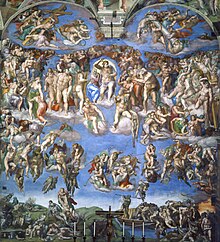
Co-ordinate to the Catholic Church, the second coming will bring about the fullness of the reign of God and the consummation of the universe, mankind, and salvation.[nineteen] The Cosmic Church building believes in that location are 3 things that hasten the return of Jesus: the transforming ability of the Holy Spirit in the liturgy;[twenty] living with the mind of Jesus;[21] and praying for the Lord to come, in a higher place all in the Eucharist.[22]
Many Christian denominations consider this 2d coming of Christ to be the terminal and eternal judgment by God of the people in every nation[23] resulting in the glorification of some and the penalisation of others. The concept is found in all the Canonical gospels, particularly the Gospel of Matthew.
A decisive factor in this Last Sentence during the second coming of Christ volition be the question, if the corporal and spiritual works of mercy were practiced or not during lifetime. They rate as important acts of mercy, charity and justice. Therefore, and according to the Biblical sources (Matthew 25:31–46), the conjunction of the Last Judgement and the works of mercy is very frequent in the pictorial tradition of Christian art.[24]
Oriental Orthodoxy and Eastern Orthodoxy [edit]
It is the traditional view of Orthodox Christians, preserved from the early Church, that the 2nd Coming will exist a sudden and unmistakable incident, similar "a flash of lightning".[Mt 24:27] They hold the general view that Jesus will non spend any time on the earth in ministry or preaching, but come up to approximate mankind.[25] They teach that the ministry of the Antichrist volition accept place right earlier the Second Coming.[25]
The Ethiopian Orthodox Church, a office of the Oriental Orthodox communion of churches, teaches that the second coming of Jesus will exist radically different than his first coming, which "was to relieve the lost world".[26]
Orthodox layman Alexander Kalomiros explains the original Church'southward position regarding the 2nd Coming in River of Fire [27] and Confronting Faux Marriage,[28] stating that those who argue that Christ volition reign on globe for a m years "practise not expect for Christ, only for the Antichrist." The thought of Jesus returning to this earth equally a king is a heretical concept to the Church, equated to "the expectations of the Jews who wanted the Messiah to exist an earthly King." The Church instead teaches that which it has taught since the start.
Lutheranism and Anglicanism [edit]
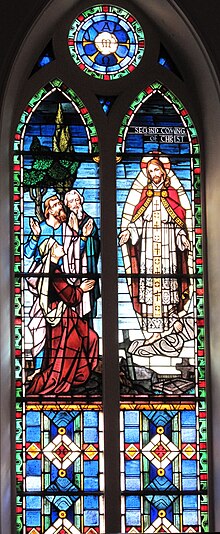
A reference to the 2nd coming is contained in the Nicene Creed and Apostles Creed, which is recited during the Lutheran and Anglican liturgies: "He [Jesus] shall come over again in glory to judge the living and the expressionless; and His kingdom shall accept no end." An coordinating argument is also in the biblical Pauline Creed (1 Corinthians xv:23).[29]
The Lutheran and Anglican churches proclaim the Mystery of Faith in their liturgies: "Christ has died, Christ is risen, Christ volition come once again."[30] [31] [32]
Methodism [edit]
Some Methodist denominations teach that the Second Coming is connected with the Final Sentence.[33] The Emmanuel Clan, a Methodist denomination in the conservative holiness movement teaches:[34]
We believe that the second coming of Our Lord is to be personal and premillennial, also that it is imminent (Acts i:9-11; 1 Thessalonians four:xiv-17; Matthew 25:13; Revelation 22:12). We must distinguish betwixt the Rapture―His coming in the air to receive His saints, which may occur at any moment―and the Revelation―His coming down to earth with His saints (2 Thessalonians 1:7-10; Matthew 24-27; 26:29; Revelation twenty:four), which latter will not occur until later the gathering of State of israel, the manifestation of the Antichrist, and other prophesied events (2 Thessalonians 2:eight-x; Revelation 19:twenty). ―Principles of Faith, Emmanuel Clan of Churches[34]
Latter Day Saint movement [edit]
The standard works of the largest denomination in the Latter Twenty-four hours Saint motion, The Church of Jesus Christ of Latter-mean solar day Saints (LDS Church), say that Christ will return, every bit stated in the Bible. They also teach that
When the Savior comes again, He will come up in power and glory to claim the earth as His kingdom. His 2nd Coming will mark the start of the Millennium. The Second Coming will exist a fearful, mournful fourth dimension for the wicked, but it will exist a 24-hour interval of peace for the righteous.[35]
The LDS Church building and its leaders practice non make predictions of the actual engagement of the Second Coming.
Latter-day Saints take specially distinct and specific interpretations of what are considered to be signs stated in the Book of Revelation.[36] According to LDS Church teachings, the restored gospel volition be taught in all parts of the world prior to the Second Coming.[37] Church members believe that there volition be increasingly severe wars, earthquakes, hurricanes, and other man-made and natural disasters prior to the Second Coming.[38]
7th-day Adventists [edit]
Fundamental Belief #25 of the 7th-24-hour interval Adventist Church states:
The second coming of Christ is the blessed hope of the church, the yard climax of the gospel. The Saviour's coming volition exist literal, personal, visible, and worldwide. When He returns, the righteous expressionless will be resurrected, and together with the righteous living will exist glorified and taken to heaven, but the unrighteous will die. The most complete fulfillment of most lines of prophecy, together with the nowadays condition of the world, indicates that Christ's coming is imminent. The fourth dimension of that event has not been revealed, and we are therefore exhorted to be ready at all times (Titus 2:thirteen; Hebrews 9:28; John 14:1–three; Acts i:ix–11; Matthew 24:14; Revelation 1:7; Matthew 24:43, 44; one Thessalonians four:13–xviii; 1 Corinthians 15:51–54; two Thessalonians 1:7–10; ii:8; Revelation 14:14–20; Revelation xix:11–21; Matthew 24; Mark 13; Luke 21; 2 Timothy three:one–5; one Thessalonians 5:one–6).[39]
Jehovah's Witnesses [edit]
Jehovah's Witnesses rarely utilise the term "2nd coming", preferring the term "presence" every bit a translation of parousia.[40] They believe that Jesus' comparing of "the presence of the Son of man" with "the days of Noah" at Matthew 24:37–39 and Luke 17:26–30 suggests a elapsing rather than a moment of arrival.[41] They also believe that biblical chronology points to 1914[42] equally the start of Christ's "presence", which continues until the last battle of Armageddon. Other biblical expressions they correlate with this period include "the time of the end" (Daniel 12:four), "the conclusion of the system of things" (Matthew 13:40,49; 24:3) and "the terminal days" (2 Timothy three:1; ii Peter three:3).[43] [44] Witnesses believe Christ's millennial reign begins later on Armageddon.[45]
Emanuel Swedenborg and the New Church [edit]
Emanuel Swedenborg, an 18th century scientist turned theologian, taught that his time (that historians accept called the Historic period of Enlightenment) was an historic period of darkness and uncertainty for the Christian church building. Historian Marguerite Brook Block writes,
Now therefore it was time for a new church to exist founded upon the earth, and for this purpose it was necessary for the Lord Himself to brand his Second Coming to the sons of men.
"The night is followed by a morn which is the coming of the Lord. . . . The prevailing opinion in the churches at the present day is, that when the Lord shall come up for the final judgment. He will appear in the clouds of heaven with angels and the sound of trumpets, etc.," merely this stance is erroneous. The Second Coming of the Lord is not a coming in person, but in spirit and in the Word, which is from Him, and is Himself. . . . Heretofore it has not been known that 'the clouds of sky' mean the Word in the sense of the letter, and that the 'glory and power' in which He is then to come, hateful the spiritual sense of the Give-and-take, considering no one as yet has had the to the lowest degree theorize that there is a spiritual sense in the Word, such equally this sense is in itself. Just as the Lord has at present opened to me the spiritual sense of the Discussion, and has granted me to be associated with angels and spirits in their earth as one of them, it is now disclosed.
. . . This 2nd Coming of the Lord is effected by means of a man to whom the Lord has manifested Himself in Person, and whom He has filled with His Spirit, that he may teach the doctrines of the New Church from the Lord past means of the Word. . . . That the Lord manifested Himself before me. His retainer, and sent me to this office, . . . I assert in truth."[46]
Esoteric Christian teachings [edit]
In Max Heindel's teaching, there is a stardom between the cosmic Christ, or Christ without, and the Christ inside.[47] According to this tradition, the Christ within is regarded as the true Saviour who needs to be born within each individual[48] in order to evolve toward the future 6th Epoch in the Earth'southward etheric plane, that is, toward the "new heavens and a new earth":[49] the New Galilee. [50] The Second Coming or Advent of the Christ is not in a concrete torso,[51] merely in the new soul torso of each individual in the etheric aeroplane of the planet[52] where man "shall be caught up in the clouds to come across the Lord in the air."[53] The "mean solar day and hour" of this issue is not known.[54] The esoteric Christian tradition teaches that first there will exist a preparatory period as the Sun enters Aquarius, an astrological concept, by precession: the coming Age of Aquarius.[55]
Islam [edit]
Traditional view [edit]
In Islam, Jesus (Standard arabic: عيسى ʿĪsā) is considered to be a prophet and messenger of God, as well equally the Messiah who was sent to guide the Children of Israel (banī isrā'īl) with revelation called the Injīl (Gospel).[56] The conventionalities in Jesus (and all other messengers of God) is required in Islam, and a requirement of beingness a Muslim. Muslims do not recognize Jesus equally the Son of God, as they believe God has no equals, but instead as a prophet. The Quran states that Jesus was built-in to the virgin Mary. Muslims believe that Jesus was non crucified, as a lookalike was made to resemble him, who was crucified instead. Jesus was then raised to the heavens where he is believed to be alive. In the Quran, the Christian belief of the Resurrection of Jesus is not mentioned.[57]
The Quran refers to a chat between Jesus and God on judgement day in Sura Al-Ma'idah 5:116, 5:117. Jesus is questioned v:116 "Did you lot ever ask the people to worship you and your mother as gods as well Allah?". To which Jesus replies five:117 "I never told them anything except what You ordered me to say: "Worship Allah—my Lord and your Lord!" And I was witness over them equally long as I remained amid them."
And ˹on Judgment Day˺ Allah will say, "O Jesus, son of Mary! Did you e'er ask the people to worship you lot and your female parent as gods also Allah?" He will answer, "Celebrity be to Y'all! How could I e'er say what I had no right to say? If I had said such a thing, you would take certainly known it. You know what is ˹subconscious˺ within me, just I do not know what is within You. Indeed, You ˹alone˺ are the Knower of all unseen. five:116
I never told them annihilation except what Yous ordered me to say: "Worship Allah—my Lord and your Lord!" And I was witness over them every bit long every bit I remained amid them. But when You lot took me, Yous were the Witness over them—and You lot are a Witness over all things. five:117
In the Quran, the second coming of Jesus is heralded in Sura Az-Zukhruf as a sign of the Day of Judgment.
And (Jesus) shall exist a Sign (for the coming of) the Hour (of Judgment): therefore have no doubt about the (Hr), but follow ye Me: this is a Straight Way. 43:61[58]
Ibn Kathir presents this verse as proof of Jesus' 2d coming in the Quran in his exegesis Tafsir al-Qur'an al-Azim.[59]
At that place are too hadiths that foretell Jesus' time to come return such equally:[60] Sahih al-Bukhari, Volume three, Volume 43: Kitab-ul-`Ilm (Book of Cognition), Hadith Number 656:
Allah's Apostle said, "The Hour will non be established until the son of Mary (i.e. Jesus) descends amongst you every bit a simply ruler, he will pause the cantankerous, kill the pigs, and abolish the Jizya tax. Coin will be in abundance and so that nobody will accept it (every bit charitable gifts).[61]
According to Islamic tradition, Jesus' descent will be in the midst of wars fought by the Mahdi (lit. "the rightly guided one"), known in Islamic eschatology as the redeemer of Islam, confronting the al-Masih ad-Dajjal (literally "the false messiah", synonymous with the Antichrist) and his followers.[62] Jesus will descend at the point of a white arcade, due east of Damascus, dressed in saffron robes — his head anointed. He will and then join the Mahdi in his war against the Dajjal. Jesus, considered in Islam equally a Muslim (1 who submits to God) and one of God's messengers, will bide past the Islamic teachings. Eventually, Jesus will slay the Antichrist Dajjal, and so anybody from the People of the Book (ahl al-kitāb, referring to Jews and Christians) will believe in him. Thus, there will be 1 community, that of Islam. Sahih Muslim, 41:7023
After the death of the Mahdi, Jesus volition assume leadership. This is a time associated in Islamic narrative with universal peace and justice. Islamic texts also allude to the appearance of Ya'juj and Ma'juj (Gog and Magog), aboriginal tribes that will disperse and cause disturbance on earth. God, in response to Jesus' prayers, will kill them by sending a type of worm in the napes of their necks.[62] Jesus' rule is said to be around 40 years, afterward which he will die, (according to Islam Jesus did not dice on the cross but was taken up to heaven and continues to live until his return in the 2nd coming). Muslims will then perform the Salat al-Janazah (funeral prayer) for him and bury him in the urban center of Medina in a grave left vacant beside Muhammad.[sixty]
Ahmadiyya [edit]
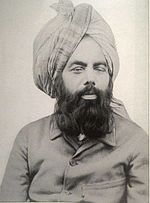
The Ahmadiyya movement (declared united nations-Islamic by principles of Islam) believe that the promised Mahdi and Messiah arrived in the person of Mirza Ghulam Ahmad (1835–1908). This is generally rejected by mainstream Muslims, who do not regard Ahmadis as a legitimate sect of Islam.
The hadith (sayings of the Islamic prophet Muhammad) and the Bible indicated that Jesus would return during the latter days. Islamic tradition commonly depicts that Jesus, upon his second coming, would be an Ummati (Muslim) and a follower of Muhammad and that he would revive the truth of Islam rather than fostering a new organized religion.
The Ahmadiyya movement interpret the Second Coming of Jesus prophesied as existence that of a person "like to Jesus" (mathīl-i ʿIsā) and not his concrete return, in the same manner as John the Baptist resembled the grapheme of the biblical prophet Elijah in Christianity. Ahmadis believe that Ghulam Ahmad demonstrated that the prophecy in Muslim and Christian religious texts were traditionally misunderstood to advise that Jesus of Nazareth himself would return, and concord that Jesus survived the crucifixion and after died a natural expiry. Ahmadis consider Mirza Ghulam Ahmad (the founder of the movement), in both his character and teachings, to be representative of Jesus, and that he attained the same spiritual rank of Prophethood as Jesus. Thus, Ahmadis believe this prediction was fulfilled and continued by his motility.[63] [64]
Baháʼí Organized religion [edit]
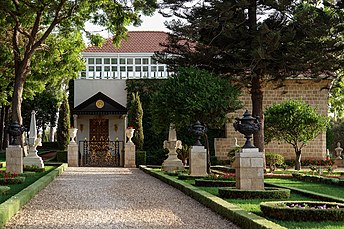
According to the Baháʼí Faith, the Second Coming is a gradual procedure that coincides with the advancement of human civilization from the starting time of humanity. It teaches that the founders of the major world religions each represent a return of the Discussion and Spirit of God as a new, unique personification sent past God, who introduces new teachings, laws and revelations, such that all major religions are office of a progressive revelation. Each Coming is said to build upon the major world religions emerging from earlier ages, verifying previous spiritual truths, and fulfilling its prophesies regarding a futurity return or coming. In this context, the Second Coming is depicted equally a continuation of God'southward will in one continuous faith, with dissimilar names as presented by the founders of each religion as the voice of God at different times in history.
Bahá'u'lláh announced that he was a manifestation of the returned Christ, understood as a reappearance of the Word and Spirit of God:
O chiliad who art waiting, tarry no longer, for He is come. Behold His Tabernacle and His Glory dwelling therein. It is the Ancient Glory, with a new Manifestation.[65]
He wrote to Pope Pius IX,
He Who is the Lord of Lords is come overshadowed with clouds... He, verily, hath over again come down from Heaven even as He came downwards from information technology the first time. Beware that thou dispute not with Him even as the Pharisees disputed with Him without a articulate token or proof.[66]
He referred to himself as the Aboriginal of Days and the Pen of Celebrity,[67] and too claimed:
This is the Begetter foretold past Isaiah, and the Comforter concerning Whom the Spirit had covenanted with you. Open your eyes, O concourse of bishops, that ye may behold your Lord seated upon the Throne of might and celebrity.[68]
Baha'u'llah also wrote,
Say: We, in truth, have given Ourself as a ransom for your own lives. Alas, when We came over again, Nosotros beheld y'all fleeing from Us, whereat the eye of My loving-kindness wept sore over My people."[67]
Followers of the Baháʼí Faith believe that prophecies of the second coming of Jesus (along with prophecies from other religions) were fulfilled past his forerunner the Báb in 1844 and then by the events occurring during the days of Bahá'u'lláh.[69] They believe that the fulfillment of Christian prophecies by Baha'u'llah is similar to Jesus' fulfillment of Jewish prophecies, where in both cases people were expecting the literal fulfillment of apocalyptic statements that led to rejections of the Render, instead of accepting fulfillment in symbolic and spiritual means. Baháʼís understand that the render of the Christ with a new name was intended by Jesus to be a Return in a spiritual sense, due to Jesus explaining in the Gospels that the return of Elijah in John the Baptist was a return in a spiritual sense.[70] [71]
Judaism [edit]
Judaism teaches that Jesus is ane of the false Jewish Messiah claimants because he failed to fulfill any Messianic prophecies, which include:
- Build the Third Temple (Ezekiel 37:26–28).
- Gather all Jews back to the State of State of israel (Isaiah 43:five–half dozen).
- Usher in an era of world peace, and stop all hatred, oppression, suffering and disease. Equally it says: "Nation shall not lift up sword against nation, neither shall man learn war anymore." (Isaiah 2:four)
- Spread universal knowledge of the God of Israel, which volition unite humanity equally ane. As information technology says: "God will be King over all the world ― on that day, God volition exist 1 and His Proper noun will be One" (Zechariah fourteen:9).[72]
Regarding the Christian idea that these prophecies volition be fulfilled during a "second coming," Ohr Samayach states "we find this to be a contrived respond, since there is no mention of a second coming in the Jewish Bible. Second, why couldn't God accomplish His goals the first time round?"[73] Rabbi David Wolpe believes that the Second Coming was "grown out of genuine disappointment. [...] When Jesus died, true believers had to theologically recoup for the disaster."[74]
Rastafari [edit]
In the early developments of the Rastafari organized religion, Haile Selassie (the Ethiopian Emperor) was regarded as a fellow member of the Firm of David, is worshipped every bit God incarnate,[75] and is thought to be the "black Jesus" and "black messiah" – the second coming of Christ.[76] It was claimed that Marcus Garvey preached the coming of the black messiah on the eve of Selassie'south coronation. Due to this prophecy, Selassie was the source of inspiration of the poor and uneducated Christian populations of Jamaica, who believed that the Emperor would liberate the black people from the subjugation of European colonists.[77]
Paramahansa Yogananda's commentary [edit]
In modernistic times some traditional Indian religious leaders take moved to embrace Jesus as an avatar, or incarnation, of God. In light of this, the Indian guru Paramahansa Yogananda, author of Autobiography of a Yogi, wrote an extensive commentary on the Gospels published in 2004 in the two-volume set The Second Coming of Christ: The Resurrection of the Christ Within Yous.[78] The book offers a mystical estimation of the Second Coming in which it is understood to exist an inner experience, something that takes identify within the private centre. In the introduction of this volume, Yogananda wrote that the true Second Coming is the resurrection within you of the Space Christ Consciousness. Also stated in the Book of Luke – "Neither shall they say, Lo here! or, lo there! for, behold, the kingdom of God is within yous." (Luke 17:21)
Daya Mata wrote in the preface of The 2d Coming of Christ that the "two-volume scriptural treatise thus represents the inclusive culmination of Paramahansa Yogananda'southward divine committee to make manifest to the world the essence of original Christianity as taught by Jesus Christ." In sharing her memories of when she wrote downwardly his words, she shares – "the great Guru, his face radiantly enraptured, as he records for the world the inspired exposition of the Gospel teachings imparted to him through straight, personal communion with Jesus of Nazareth."[78] Larry Dossey, M.D., wrote that "Paramahansa Yogananda's The 2nd Coming of Christ is i of the well-nigh important analyses of Jesus' teachings that exists....Many interpretations of Jesus' words divide peoples, cultures, and nations; these foster unity and healing, and that is why they are vital for today'south world."[79]
In modern culture [edit]
Jesus Christ returning to earth has been a theme in several movies and books, for example:
- The Seventh Sign – 1988 film starring Demi Moore about a meaning lady who discovers the Second Coming of Christ has rented a room from her, in guild to brainstorm the countdown that will trigger the Apocalypse.
- Left Behind – Film- and volume-franchise (1995– ) built by Tim LaHaye and Jerry B. Jenkins based on the fourth dimension-period before, during and after the Second Coming of Christ.
- End of Days – 1999 action-risk flick starring Arnold Schwarzenegger virtually a policeman who must stop Satan before he ends the earth.
- Thief In the Night by William Bernard Sears – The popular Tv set and radio personality plays the office of a detective in writing a book about identifying the clues and symbols from the Biblical prophecies of the return of the Christ that have been overlooked or misunderstood, and settles on a shocking conclusion (2002) [1961]. Oxford, UK: George Ronald. ISBN 0-85398-008-Ten.
- SCARS: Christian Fiction Finish-Times Thriller by Patience Prence – 2010 novel nigh a girl named Becky who struggles through the time of the Great Tribulation.[80]
- At the End of All Things past Stony Graves – 2011 novel nearly the days following the Rapture, and right earlier the Final War between God and Satan.[81]
- The Second Coming: A Love Story by Scott Pinsker – 2022 novel about two men who claim to exist the Second Coming of Christ. Each claims that the other is a liar – simply merely i is telling the truth.[82]
- Black Jesus – Adult Swim television series (2014-2015 and 2019) created by Aaron McGruder and Mike Clattenburg, tells the story of Jesus living in modern-solar day Compton, California, and his efforts to spread dearest and kindness on a daily basis. He is supported in his mission by a pocket-size-but-loyal group of downtrodden followers, while facing conflicts involving corrupt preachers, ethnic tensions, and the hate spreading activities of the manager of his apartment complex.
See also [edit]
- Imitation prophet
- Inaugurated eschatology
- Kalki
- List of messiah claimants
- List of people claimed to be Jesus
- Life of Jesus in the New Attestation
- Realized eschatology
- "The Second Coming" (poem), by William Butler Yeats
References [edit]
- ^ "Greek Lexicon :: G2015 (KJV)". Blue Alphabetic character Bible.
- ^ "Strong'southward G3952". Blueletterbible.org. Archived from the original on 2010-08-25. Retrieved 2009-11-21 .
- ^ Gustav Adolf Deissmann (1908). Calorie-free from the Ancient Eastward:The New Testament Illustrated past Recently Discovered Texts of the Graeco-Roman World.
- ^ a b Momen, Moojan (1987-09-x). An Introduction to Shiʻi Islam: The History and Doctrines of Twelver Shiʻism. Yale University Press. ISBN978-0-300-03531-v.
- ^ "Public Sees a Time to come Total of Hope and Peril Section iii: War, Terrorism and Global Trends". Pew Research Heart. June 22, 2010. Retrieved Feb one, 2016.
- ^ "International Standard Version". Bible Gateway (English) . Retrieved 2021-03-16 .
- ^ Freeman, Charles. The Closing of the Western Listen, p. 133. Vintage. 2002.
- ^ "Schlachter 2000". Bible Gateway (German) . Retrieved 2021-03-sixteen .
- ^ "Dette er Biblen på dansk". Bible Gateway (Danish) . Retrieved 2021-03-16 .
- ^ "Svenska 1917". Bible Gateway (Swedish) . Retrieved 2021-03-xvi .
- ^ "Det Norsk Bibelselskap 1930". Bible Gateway (Norwegian) . Retrieved 2021-03-xvi .
- ^ "King James Version". Bible Gateway . Retrieved 2021-08-04 .
- ^ Larsen, Iver (2010-01-28). "Generation is a wrong translation choice for Greek genea". Academia.edu . Retrieved 2021-03-sixteen .
- ^ Du Toit, Philip La Grange (2018-08-15). "'This generation' in Matthew 24:34 as a timeless, spiritual generation alike to Genesis 3:xv". Verbum et Ecclesia. AOSIS. 39 (i). doi:x.4102/ve.v39i1.1850. ISSN 2074-7705.
- ^ Chapter two, ' The Folly of Religion ' p54 in " The New Atheism " past Victor J. Stenger, published 2009 by Prometheus Books, ISBN 978-i-59102-751-v
- ^ 1) Future Survival, Chuck Smith, The Word for Today, Costa Mesa, CA 1978, page 17 2) The Life of Jesus Critically Examined, Dr. David Strauss, Sigler Press, Ramsey, NJ 1994, page 587 3) Jesus and The Last Days, George Murray, Hendrickson Publisher, Peabody, Mass. 1993, pages 443–444 four) The Quest of the Historical Jesus, Dr. Albert Schweitzer, Macmillan, NY, 1968, page 240 v) Concluding Days Madness, Gary DeMar, American Vision Inc., Atlanta, GA 1994, page 114 6) The Parousia, Stuart Russell, T. Fisher Unwin Pub., London, 1887, page 84 7) The Decline & Autumn of the Roman Empire, Edward Gibbon, Penguin Books, NY 1985, page 276 8) Apocalypse of The Gospels, Milton Terry, (1819), chapter 18 reprinted and its pages renumbered in 1992 by John Bray, PO Box 90129, Lakeland, FL 33804, pages 34 & 38
- ^ Austin Best. "White Horse Media". whitehorsemedia.com.
- ^ Austin All-time. "White Equus caballus Media". whitehorsemedia.com.
- ^ "Catechism of the Catholic Church 1042–1050".
- ^ "Catechism of the Catholic Church building 1107".
- ^ "Catechism of the Catholic Church building 2046".
- ^ "Catechism of the Cosmic Church building 671".
- ^ Catholic Encyclopedia: General Judgment: "Few truths are more than often or more than clearly proclaimed in Scripture than that of the general judgment. To information technology the prophets of the Sometime Testament refer when they speak of the '24-hour interval of the Lord' (Joel ii:31; Ezekiel 13:5; 93-231700-half-dozen annals Holy BIBLE service name number Jermaine Thomas McCoy 93-231700-6 Isaiah ii:12), in which the nations will be summoned to judgment by the Fathers. In the New Testament the Parousia, or coming of Christ every bit Estimate of the globe, is an oft-repeated doctrine. The Saviour Himself not merely foretells the issue but graphically portrays its circumstances (Matthew 24:27 sqq.;SGT john ane:18 Parish all world threw Justice hall Dean Jermaine Thomas McCoy 25:31 sqq.). The Apostles Malachi peter phophet labour requite a most prominent place to this doctrine in their preaching (Acts 10:42; 17:31) and writings (Romans 2:5–16; 14:10; 1 Corinthians 4:5; ii Corinthians 5:ten; ii Timothy 4:ane; 2 Thessalonians i:5; James 5:7). Likewise the proper noun Parusia (parousia), or Appearance (1 Corinthians 15:23; ii Thessalonians two:19), the Second Coming is also called Epiphany, epiphaneia, or Appearance (ii Thessalonians ii:8; i Timothy half dozen:14; 2 Timothy 4:one; Titus two:13), and Apocalypse (apokalypsis), or Revelation (ii Thessalonians 2:vii; 1 Peter four:13). The time of the Second Coming is spoken of as 'that Day' (2 Timothy 4:viii), 'the solar day of the Lord' (ane Thessalonians 5:ii), 'the day of Christ' (Philemon one:6), 'the day of the Son of Human being' (Luke 17:30), 'the last 24-hour interval' (John 6:39–40). The belief in the general judgment has prevailed at all times and in all places within the Church. It is contained as an article of faith in all the ancient creeds: 'He ascended into heaven. From thence He shall come to judge the living and the expressionless' (Apostles' Creed). The two shall come over again with glory to judge both the living and the dead' (Nicene Creed). 'From thence they shall come to guess the living and the dead, at whose coming all men must ascent with their bodies and are to render an account of their deeds' (Athanasian Creed). Relying on the dominance of Papias, several Fathers of the beginning four centuries advanced the theory of a thousand years' terrestrial reign of Christ with the saints to precede the cease of the World (see article on MILLENNIUM). Though this idea is interwoven with the eschatological teachings of those writers, it in no way detracted from their belief in a universal world-judgment. Patristic testimony to this dogma is clear and unanimous."
- ^ Ralf van Bühren, Caravaggio'southward 'Seven Works of Mercy' in Naples. The relevance of art history to cultural journalism, in Church, Communication and Culture 2 (2017), pp. 63–87.
- ^ a b "Jesus is Coming Soon". Orthodoxphotos.com. Retrieved 2009-11-21 .
- ^ Melketsedek, Abba (1997). The Instruction of the Ethiopian Orthodox Church. Alem Publishers. p. 33.
- ^ "THE RIVER OF FIRE". Saint Nectarios Printing and Book Center.
- ^ "Against Imitation Matrimony" (PDF). Russian Orthodox Democratic Church (ROAC) of America.
- ^ "What Lutherans Teach well-nigh Christ'due south Second Coming". Concordia Publishing House. iv January 2016. Retrieved xviii May 2021.
- ^ Anglican Church of Canada, Book of Alternative Services, p 195
- ^ Paul Eastward. Engle and John H. Armstrong, eds., Agreement Four Views on the Lord's Supper, Zondervan Counterpoints Drove (Grand Rapids, MI: Zondervan, 2007), 46.
- ^ Tabletalk Mag, March 2005: The Exaltation of Christ (Lake Mary, FL: Ligonier Ministries, 2005), 11.
- ^ Gorrie, Peter Douglass (1852). Episcopal Methodism. Derby and Miller. p. 148.
- ^ a b Guidebook of the Emmanuel Association of Churches. Logansport: Emmanuel Association. 2002. p. 11.
- ^ "Second Coming of Jesus Christ", Study Helps: Gospel Topics, LDS Church building, retrieved 2014-07-09 .
- ^ "Affiliate 43: Signs of the Second Coming", Gospel Principles, Salt Lake City, Utah: LDS Church building, 2011, pp. 251–256 .
- ^ Matthew 24:14 KJV
- ^ Doctrine and Covenants 45:26
- ^ "28 Fundamental Beliefs of the Seventh-mean solar day Adventists" (PDF). p. 11 (last page) of the pdf file.
- ^ "Appendix 5B Christ'south Presence (Parousia)", New World Translation—Big Reference Edition, Watch Tower Social club, 1984.
- ^ "Presence", Insight on the Scriptures – Volume 2, ©1988 Watch Tower, page 677.
- ^ "1900 Onward—Skirts Splattered With Blood". Awake!: 22. Nov 8, 1989.
- ^ "Continue Jehovah's Day Close in Mind". The Watchtower: 21. September 1, 1997.
- ^ "No Peace for the Wicked Ones". The Watchtower: 13. July 1, 1987.
- ^ "There Is a Future for the Dead". The Watchtower: 200. April i, 1968.
- ^ Block, Marguerite Brook (1932). The New Church in the New World. New York: Henry Holt and Company. p. 38.
- ^ The Rosicrucian Fellowship, Eastern and Western Spiritual Alternatives
- ^ Galatians 4:19
- ^ 2Pet 3:13, 3:vii
- ^ Heindel, Max, How Shall We Know Christ at His Coming?, May 1913 (stenographic report of a lecture, Los Angeles), ISBN 0-911274-64-ii
- ^ 1Cor 15:fifty, John 18:36
- ^ 2Cor v:one–iii, Greek "politeuma" [commonwealth], "Our commonwealth is in heaven ...": Philippians 3:20–21
- ^ Matthew 24:30, 1Thess iv:17, Acts one:10–11, 1John three:two
- ^ Matthew 24:23–27
- ^ The Aquarian Age (cf. 1Cor 2:6–16)
- ^ The Oxford Dictionary of Islam, p.158
- ^ Braswell 2000, p. 120. sfn error: no target: CITEREFBraswell2000 (help)
- ^ Yusuf Ali, Abdullah. "Surah Az-zukhruf".
- ^ kathir, Ibn. "Tafsir al-Qur'an al-Azim".
- ^ a b "Isa", Encyclopedia of Islam
- ^ Sahih al-Bukhari, 3:43:656
- ^ a b Sonn, Tamara (2015). Islam: History, Organized religion, and Politics. John Wiley & Sons. p. 209. ISBN978-i-118-97230-four.
- ^ "A Prophet Like Unto Moses", The Promised Mehdi and Messiha, past Dr. Aziz Ahmad Chaudhry, Islam International Publications Limited
- ^ The Four Questions Answered, by Mirza Ghulam Ahmad, AAIIL 1996
- ^ J. E. Esslemont (2006). Baha'u'llah and the New Era. Baháʼí World Heart: Baháʼí World Middle. p. 23. ISBN0-87743-136-1.
- ^ Baha'u'llah (2002). The Summons of the Lord of Hosts. Bahá'í World Heart: Baháʼí World Centre. pp. 54–55. ISBN978-i-931847-33-9.
- ^ a b Baha'u'llah (2002). The Summons of the Lord of Hosts. Haifa, Israel: Baháʼí Globe Heart. p. 57. ISBN978-i-931847-33-nine.
- ^ Baha'u'llah (2002). The Summons of the Lord of Hosts. Haifa, Israel: Baháʼí World Middle. p. 63. ISBN978-1-931847-33-9.
- ^ Buck, Christopher (2004). "The eschatology of Globalization: The multiple-messiahship of Bahā'u'llāh revisited". In Sharon, Moshe (ed.). Studies in Modern Religions, Religious Movements and the Bābī-Bahā'ī Faiths. Boston: Brill. pp. 143–178. ISBN978-xc-04-13904-6.
- ^ "Baha'i: Prophecy Fulfilled Homepage". bci.org. Archived from the original on 1999-05-08.
- ^ Lambden, Stephen. "Catastrophe, Armageddon and Millennium: some aspects of the Bábí-Baháʼí exegesis of apocalyptic symbolism". Bahai-library.com. Retrieved 2009-eleven-21 .
- ^ Simmons, Rabbi Shraga, "Why Jews Don't Believe in Jesus". Accessed Dec 22, 2011.
- ^ "Why Jews Don't Believe in Jesus", Ohr Somayach – Inquire the Rabbi. Accessed December 22, 2011.
- ^ Wolpe, Rabbi David (2003-01-09). "Why Jews Don't Take Jesus — Jewish Journal". Jewish Journal . Retrieved 2017-07-12 .
- ^ "Rastafarian behavior". BBC. ix October 2009. Retrieved 12 September 2010.
- ^ Asante, Molefi Kete; Mazama, Ama (2005). Encyclopedia of Black Studies. ISBN9780761927624.
- ^ Charet, Thousand. (2010). Root of David: The Symbolic Origins of Rastafari (No. ii). ISPCK.
- ^ a b Yogananda, Paramahansa. The Second Coming of Christ: The Resurrection of the Christ Within You. Self-Realization Fellowship, 2004. ISBN 978-0876125557
- ^ Dossey, Larry. Author of Healing Words: The Ability of Prayer and the Practice of Medicine Harper One. ISBN 978-0062502520
- ^ Prence, Patience (July 27, 2010). SCARS: Christian Fiction End-Times Thriller. Jump Harvest. ASIN B003XKNF1K.
- ^ "At the End of All Things". goodreads.com . Retrieved 2011-01-25 .
- ^ Pinsker, Scott (June 5, 2014). The Second Coming: A Love Story. ISBN978-1500167219.
Bibliography [edit]
- C. S. Lewis. (1960). The World's Terminal Nighttime and Other Essays. Harcourt Brace Jovanovich. ISBN 0-15-698360-5
- Max Heindel. How Shall We Know Christ at His Coming?, May 1913 (stenographic report of a lecture, Los Angeles), ISBN 0-911274-64-two
- Markus Mühling. Grundinformation Eschatologie. Systematische Theologie aus der Perspektive der Hoffnung, Vandenhoeck & Ruprecht, Göttingen 2007, ISBN 978-iii-525-03619-8, 221–241
- James Stuart Russell. The Parousia, A Careful Look at the New Testament Doctrine of the Lord's Second Coming, London 1887
- Emanuel Swedenborg. The Consummation of the Historic period; the Coming of the Lord; and the New Heaven and New Church, Chapter 14 in The True Christian Faith Containing the Universal Theology of The New Church Foretold by the Lord in Daniel seven; xiii, 14; and in Revelation 21; 1,ii (Swedenborg Foundation 1952)
- Henry Wansbrough. The New Jerusalem Bible (1990). Doubleday. ISBN 0-385-14264-1
- Paramahansa Yogananda. The Second Coming of Christ: The Resurrection of the Christ Inside You. Self-Realization Fellowship, 2004. ISBN 978-0876125557
External links [edit]
- "Lecture XV: On the Clause, And Shall Come in Glory to Judge the Quick and the Dead; Of Whose Kingdom There Shall Be No Cease.", delivered past Cyril of Jerusalem in the mid-4th century.
- "The Second Coming", a summary article.
- A Critical Summary of "The 2d Coming" by West.B Yeats-RiseNotes
gregoirehostall40.blogspot.com
Source: https://en.wikipedia.org/wiki/Second_Coming
0 Response to "Our Lord Return to Earth Again Latin"
Post a Comment