What Do You Know About Secret Agents
Espionage, spying or intelligence gathering is the act of obtaining clandestine or confidential data (intelligence) from non-disclosed sources or divulging of the same without the permission of the holder of the information for a tangible benefit. A person who commits espionage is called an espionage agent or spy.[one] Any private or spy ring (a cooperating group of spies), in the service of a authorities, company, criminal system, or independent operation, can commit espionage. The practice is clandestine, as information technology is by definition unwelcome. In some circumstances, it may be a legal tool of law enforcement and in others, it may exist illegal and punishable by law.
Espionage is often role of an institutional try by a authorities or commercial business. All the same, the term tends to be associated with state spying on potential or actual enemies for armed services purposes. Spying involving corporations is known every bit industrial espionage.
1 of the most effective ways to gather data and information about a targeted organization is by infiltrating its ranks. This is the job of the spy (espionage agent). Spies can and so return data such as the size and forcefulness of enemy forces. They can also find dissidents within the arrangement and influence them to provide further information or to defect.[2] In times of crunch, spies steal technology and demolition the enemy in various ways. Counterintelligence is the practice of thwarting enemy espionage and intelligence-gathering. Almost all nations have strict laws concerning espionage and the penalty for being caught is often astringent. Notwithstanding, the benefits gained through espionage are oftentimes so great that most governments and many large corporations make use of it.[ citation needed ]
History [edit]
Espionage has been recognized as an importance in war machine affairs since aboriginal times.
The oldest known classified document was a report made by a spy disguised equally a diplomatic envoy in the courtroom of King Hammurabi, who died in effectually 1750 BC. The Ancient Egyptians had a developed clandestine service and espionage is mentioned in the Iliad, the Bible, and the Amarna letters besides every bit its recordings in the story of the Sometime Testament, The Twelve Spies.[3] Espionage was also prevalent in the Greco-Roman earth, when spies employed illiterate subjects in civil services.[ citation needed ]
The thesis that espionage and intelligence has a cardinal role in war also as peace was offset advanced in The Art of War and in the Arthashastra. In the Middle Ages European states excelled at what has later been termed counter-subversion when Catholic inquisitions were staged to annihilate heresy. Inquisitions were marked by centrally organised mass interrogations and detailed record keeping. During the Renaissance European states funded codebreakers to obtain intelligence through frequency analysis. Western espionage inverse fundamentally during the Renaissance when Italian city-states installed resident ambassadors in upper-case letter cities to collect intelligence. Renaissance Venice became so obsessed with espionage that the Council of X, which was nominally responsible for security, did non even let the doge to consult government athenaeum freely. In 1481 the Council of Ten barred all Venetian authorities officials from making contact with ambassadors or foreigners. Those revealing official secrets could face the death penalty. Venice became obsessed with espionage because successful international trade demanded that the city-state could protect its trade secrets. Under Elizabeth I, Francis Walsingham was appointed foreign secretarial assistant and intelligence chief.[4]
During the American Revolution, Nathan Unhurt and Benedict Arnold achieved their fame as spies, and at that place was considerable utilise of spies on both sides during the American Civil State of war.[5] [6] Though not a spy himself, George Washington was America's beginning spymaster, utilizing espionage tactics against the British.[3]

In the 20th century, at the height of Earth State of war I, all cracking powers except the United states of america had elaborate civilian espionage systems and all national military establishments had intelligence units. In order to protect the country confronting strange agents, the U.S. Congress passed the Espionage Human activity of 1917. Mata Hari, who obtained data for Germany by seducing French officials, was the virtually noted espionage agent of World War I. Prior to Globe War 2, Germany and Imperial Japan established elaborate espionage nets. In 1942 the Office of Strategic Services was founded by Gen. William J. Donovan. Nonetheless, the British system was the keystone of Centrolineal intelligence. Numerous resistance groups such as the Austrian Maier-Messner Grouping, the French Resistance, the Witte Brigade, Milorg and the Polish Home Army worked against Nazi Germany and provided the Allied secret services with information that was very important for the state of war effort.
Since the stop of World State of war Two, the activeness of espionage has enlarged, much of it growing out of the Common cold War between the U.s. and the onetime USSR. The Russian Empire and its successor, the Soviet Union have had a long tradition of espionage ranging from the Okhrana to the KGB (Committee for State Security), which also acted every bit a hole-and-corner law force. In the United States, the 1947 National Security Human action created the Key Intelligence Agency (CIA) to coordinate intelligence and the National Security Agency for research into codes and electronic communication. In addition to these, the United states of america has thirteen other intelligence gathering agencies; about of the U.S. expenditures for intelligence gathering are budgeted to various Defense Dept. agencies and their programs. Under the intelligence reorganization of 2004, the director of national intelligence is responsible for overseeing and analogous the activities and budgets of the U.Southward. intelligence agencies.
In the Common cold War, espionage cases included Alger Hiss and Whittaker Chambers and the Rosenberg Instance. In 1952 the Communist Chinese captured ii CIA agents, and in 1960 Francis Gary Powers, flying a U-2 reconnaissance mission over the Soviet Union for the CIA, was shot downwards and captured. During the Cold State of war, many Soviet intelligence officials defected to the W, including Gen. Walter Krivitsky, Victor Kravchenko, Vladimir Petrov, Peter Deriabin Pawel Monat, and Oleg Penkovsky, of the GRU (Soviet military intelligence). Among Western officials who defected to the Soviet Union are Guy Burgess and Donald D. Maclean of Uk in 1951, Otto John of West Germany in 1954, William H. Martin and Bernon F. Mitchell, U.South. cryptographers, in 1960, and Harold (Kim) Philby of United kingdom in 1962. U.S. acknowledgment of its U-ii flights and the exchange of Francis Gary Powers for Rudolf Abel in 1962 implied the legitimacy of some espionage equally an arm of foreign policy.
China has a very cost-effective intelligence program that is specially effective in monitoring neighboring countries such every bit Mongolia, Russia, and Bharat. Smaller countries can as well mount effective and focused espionage efforts. For instance, the Vietnamese Communists had consistently superior intelligence during the Vietnam State of war. Some Islamic countries, including Libya, Iran, and Syria, have highly developed operations likewise. SAVAK, the secret constabulary of the Pahlavi dynasty, was particularly feared by Iranian dissidents before the 1979 Iranian Revolution.
Today [edit]
Today, spy agencies target the illegal drug trade and terrorists as well every bit state actors. Betwixt 2008 and 2011, the United States charged at least 57 defendants for attempting to spy for Communist china.[7]
Intelligence services value certain intelligence collection techniques over others. The former Soviet Matrimony, for example, preferred human sources over research in open up sources, while the U.s. has tended to emphasize technological methods such as SIGINT and IMINT. In the Soviet Matrimony, both political (KGB) and military intelligence (GRU[8]) officers were judged by the number of agents they recruited.
The espionage efforts and noesis of a nation are oft used by other countries by hiring their intelligence employees. The United Arab Emirates is one of the major countries relying on the technique, where they have hired the quondam employees of the US' National Security Agency and the White House veterans. Some of the agents were hired to hack the Emirates' former rival nation Qatar, its royals and even FIFA officials. Others were asked to conduct surveillance on other governments, human being rights activists, social media critics, and even militants. However, the spying efforts of the UAE by using the Americans were too used to target the The states itself, including former showtime lady Michelle Obama.[9] [10]
In September 2021, three onetime intelligence officials from America admitted to working for the United Arab Emirates' DarkMatter for hacking computers, servers, and electronic devices, including the computers and servers in the United States. According to court documents, the three operatives—Daniel Gericke, Ryan Adams, and Marc Baier—helped Emirati intelligence operatives with avant-garde cyber technology to help them in breaches directed at potential enemies or political rivals. The DarkMatter also hired several other ex-Northward.Due south.A. and C.I.A. officers at salaries worth hundreds of thousands of dollars a twelvemonth.[11] [12]
Targets of espionage [edit]
Espionage agents are commonly trained experts in a targeted field then they tin can differentiate mundane data from targets of value to their own organizational development. Correct identification of the target at its execution is the sole purpose of the espionage operation.[ citation needed ]
Broad areas of espionage targeting expertise include:[ citation needed ]
- Natural resources: strategic production identification and assessment (food, energy, materials). Agents are commonly found among bureaucrats who administer these resource in their own countries
- Popular sentiment towards domestic and foreign policies (popular, middle class, elites). Agents often recruited from field journalistic crews, substitution postgraduate students and sociology researchers
- Strategic economical strengths (production, research, manufacture, infrastructure). Agents recruited from science and technology academia, commercial enterprises, and more rarely from amidst military technologists
- Military capability intelligence (offensive, defensive, manoeuvre, naval, air, space). Agents are trained past military espionage education facilities and posted to an expanse of operation with covert identities to minimize prosecution
- Counterintelligence operations targeting opponents' intelligence services themselves, such as breaching the confidentiality of communications, and recruiting defectors or moles
Methods and terminology [edit]
Although the news media may speak of "spy satellites" and the like, espionage is not a synonym for all intelligence-gathering disciplines. It is a specific form of man source intelligence (HUMINT). Codebreaking (cryptanalysis or COMINT), aircraft or satellite photography, (IMINT) and assay of publicly bachelor information sources (OSINT) are all intelligence gathering disciplines, but none of them is considered espionage. Many HUMINT activities, such equally prisoner interrogation, reports from armed services reconnaissance patrols and from diplomats, etc., are not considered espionage. Espionage is the disclosure of sensitive information (classified) to people who are not cleared for that information or access to that sensitive data.
Different other forms of intelligence collection disciplines, espionage usually involves accessing the place where the desired information is stored or accessing the people who know the data and volition divulge it through some kind of subterfuge. In that location are exceptions to physical meetings, such as the Oslo Report, or the insistence of Robert Hanssen in never meeting the people who bought his information.
The US defines espionage towards itself every bit "the act of obtaining, delivering, transmitting, communicating, or receiving information about the national defence with an intent, or reason to believe, that the data may be used to the injury of the United States or to the advantage of any foreign nation". Blackness's Constabulary Dictionary (1990) defines espionage as: "... gathering, transmitting, or losing ... information related to the national defense". Espionage is a violation of United States police force, 18 U.S.C. §§ 792–798 and Article 106a of the Uniform Code of Military machine Justice.[thirteen] The United States, like most nations, conducts espionage against other nations, nether the control of the National Underground Service.
| | This article needs to exist updated. The reason given is: What nearly the Defense Department, and the Director of National Intelligence?. (Dec 2021) |

Britain'south espionage activities are controlled by the Undercover Intelligence Service.
Engineering science and techniques [edit]
- Agent handling
- Concealment device
- Covert agent
- Covert listening device
- Cut-out
- Cyber spying
- Dead drib
- False flag operations
- Honeypot
- Impersonation
- Impostor
- Interrogation
- Non-official cover
- Numbers messaging
- Official comprehend
- One-manner vocalisation link
- Demolition
- Safe house
- Side channel attack
- Steganography
- Surveillance
- Surveillance shipping
Source: [14]
System [edit]

An intelligence officer's clothing, accessories, and behavior must exist every bit unremarkable as possible—their lives (and others') may depend on it.
A spy is a person employed to seek out top clandestine information from a source.[fifteen] Within the The states Intelligence Customs, "asset" is more than common usage. A instance officer or Special Agent, who may take diplomatic status (i.due east., official comprehend or non-official comprehend), supports and directs the homo collector. Cut-outs are couriers who do non know the agent or instance officer merely transfer messages. A safe house is a refuge for spies. Spies often seek to obtain surreptitious information from some other source.
In larger networks, the organization tin can be circuitous with many methods to avoid detection, including clandestine cell systems. Oft the players have never met. Instance officers are stationed in foreign countries to recruit and supervise intelligence agents,[15] who in plough spy on targets in the countries where they are assigned. A spy need non be a citizen of the target land and hence does not automatically commit treason when operating within it. While the more mutual exercise is to recruit a person already trusted with access to sensitive information, sometimes a person with a well-prepared synthetic identity (cover background), called a legend [fifteen] in tradecraft, may attempt to infiltrate a target arrangement.
These agents can be moles (who are recruited before they get admission to secrets), defectors (who are recruited after they get admission to secrets and exit their country) or defectors in place (who become access but do not leave).
A legend is besides employed for an individual who is non an illegal agent, merely is an ordinary citizen who is "relocated", for instance, a "protected witness". However, such a non-agent very likely will also have a case officer who will act as a controller. As in most, if not all constructed identity schemes, for whatsoever purpose (illegal or legal), the assistance of a controller is required.
Spies may also be used to spread disinformation in the organization in which they are planted, such as giving false reports about their state's military movements, or about a competing company'south ability to bring a product to market place. Spies may be given other roles that besides crave infiltration, such as demolition.
Many governments spy on their allies besides every bit their enemies, although they typically maintain a policy of not commenting on this. Governments also apply individual companies to collect information on their behalf such as SCG International Risk, International Intelligence Limited and others.
Many organizations, both national and not-national, conduct espionage operations. It should non be assumed that espionage is always directed at the most secret operations of a target country. National and terrorist organizations and other groups are also targeted.[16] This is because governments want to retrieve information that they tin can use to be proactive in protecting their nation from potential terrorist attacks.
Communications both are necessary to espionage and hole-and-corner operations, and also a great vulnerability when the adversary has sophisticated SIGINT detection and interception capability. Spies rely on COVCOM or covert communication through technically advanced spy devices.[3] Agents must also transfer money securely.
Industrial espionage [edit]
Reportedly Canada is losing $12 billion[17] and German companies are estimated to be losing nearly €50 billion ($87 billion) and thirty,000 jobs[eighteen] to industrial espionage every year.
Agents in espionage [edit]
In espionage jargon, an "agent" is the person who does the spying. They may exist a denizen of a land recruited past that land to spy on another; a citizen of a country recruited by that country to bear out faux flag assignments disrupting his own country; a citizen of ane country who is recruited past a second state to spy on or work against his own country or a third country, and more.
In popular usage, this term is sometimes confused with an intelligence officer, intelligence operative or case officer who recruits and handles agents.
Amongst the most common forms of agent are:
- Agent provocateur: instigates trouble or provides information to gather as many people equally possible into one location for an arrest.
- Intelligence amanuensis: provides admission to sensitive information through the use of special privileges. If used in corporate intelligence gathering, this may include gathering information of a corporate business venture or stock portfolio. In economic intelligence, "Economic Analysts may apply their specialized skills to clarify and interpret economic trends and developments, assess and runway foreign financial activities, and develop new econometric and modelling methodologies."[nineteen] This may also include information of merchandise or tariff.
- Agent-of-influence: provides political influence in an area of interest, possibly including publications needed to further an intelligence service agenda.[15] The use of the media to print a story to mislead a foreign service into action, exposing their operations while nether surveillance.
- Double amanuensis: engages in clandestine activity for two intelligence or security services (or more in joint operations), who provides data about one or well-nigh each to the other, and who wittingly withholds significant information from i on the instructions of the other or is unwittingly manipulated by one and so that significant facts are withheld from the adversary. Peddlers, fabricators and others who work for themselves rather than a service are not double agents because they are not agents. The fact that double agents have an amanuensis human relationship with both sides distinguishes them from penetrations, who normally are placed with the target service in a staff or officer capacity."[20]
- Redoubled amanuensis: forced to mislead the foreign intelligence service afterward beingness caught as a double agent.
- Unwitting double amanuensis: offers or is forced to recruit as a double or redoubled agent and in the procedure is recruited past either a third-party intelligence service or his own government without the knowledge of the intended target intelligence service or the agent. This tin can be useful in capturing of import information from an agent that is attempting to seek allegiance with another state. The double agent commonly has knowledge of both intelligence services and can place operational techniques of both, thus making 3rd-political party recruitment difficult or incommunicable. The knowledge of operational techniques can also affect the human relationship between the operations officer (or example officer) and the agent if the case is transferred by an operational targeting officer to a new operations officer, leaving the new officeholder vulnerable to attack. This type of transfer may occur when an officeholder has completed his term of service or when his cover is blown.
- Sleeper agent: recruited to wake up and perform a specific set up of tasks or functions while living undercover in an area of interest. This blazon of agent is not the same as a deep cover operative, who continually contacts a case officeholder to file intelligence reports. A sleeper agent is not in contact with anyone until activated.
- Triple agent: works for three intelligence services.[ how? ]
Less mutual or lesser known forms of agent include:
- Access agent: provides access to other potential agents by providing offender profiling information that can help lead to recruitment into an intelligence service.
- Confusion agent: provides misleading information to an enemy intelligence service or attempts to discredit the operations of the target in an functioning.
- Facilities agent: provides access to buildings, such every bit garages or offices used for staging operations, resupply, etc.
- Illegal agent: lives in some other state under false credentials and does not study to a local station. A nonofficial cover operative can be dubbed an "illegal"[21] when working in another country without diplomatic protection.
- Principal agent: functions as a handler for an established network of agents, commonly considered "blue scrap".
Police [edit]
Espionage against a nation is a crime under the legal lawmaking of many nations. In the United States, it is covered by the Espionage Act of 1917. The risks of espionage vary. A spy violating the host country's laws may be deported, imprisoned, or even executed. A spy violating its own country'due south laws can exist imprisoned for espionage or/and treason (which in the United states and some other jurisdictions can only occur if they take upwardly arms or aids the enemy against their own state during wartime), or even executed, as the Rosenbergs were. For example, when Aldrich Ames handed a stack of dossiers of U.South. Central Intelligence Agency (CIA) agents in the Eastern Bloc to his KGB-officeholder "handler", the KGB "rolled upward" several networks, and at least ten people were secretly shot. When Ames was arrested by the U.S. Federal Agency of Investigation (FBI), he faced life in prison; his contact, who had diplomatic immunity, was declared persona not grata and taken to the airport. Ames' married woman was threatened with life imprisonment if her husband did non cooperate; he did, and she was given a v-year sentence. Hugh Francis Redmond, a CIA officer in Communist china, spent nineteen years in a Chinese prison for espionage—and died in that location—as he was operating without diplomatic cover and amnesty.[22]
In United States police force, treason,[23] espionage,[24] and spying[25] are separate crimes. Treason and espionage have graduated punishment levels.
The The states in World War I passed the Espionage Deed of 1917. Over the years, many spies, such as the Soble spy ring, Robert Lee Johnson, the Rosenberg ring, Aldrich Hazen Ames,[26] Robert Philip Hanssen,[27] Jonathan Pollard, John Anthony Walker, James Hall Three, and others take been prosecuted under this law.
History of espionage laws [edit]
From aboriginal times, the penalization for espionage in many countries was execution. This was true right up until the era of World State of war II; for case, Josef Jakobs was a Nazi spy who parachuted into Bully Britain in 1941 and was executed for espionage.
In modernistic times, many people bedevilled of espionage have been given penal sentences rather than execution. For example, Aldrich Hazen Ames is an American CIA annotator, turned KGB mole, who was convicted of espionage in 1994; he is serving a life sentence without the possibility of parole in the high-security Allenwood U.S. Penitentiary.[28] Ames was formerly a 31-year CIA counterintelligence officeholder and analyst who committed espionage against his land past spying for the Soviet Union and Russia.[29] So far as information technology is known, Ames compromised the second-largest number of CIA agents, second only to Robert Hanssen, who is as well serving a prison sentence.
Use against non-spies [edit]
Espionage laws are also used to prosecute non-spies. In the U.s.a., the Espionage Act of 1917 was used against socialist political leader Eugene Five. Debs (at that time the Act had much stricter guidelines and amongst other things banned speech against military recruiting). The law was later used to suppress publication of periodicals, for example of Father Coughlin in World War II. In the early 21st century, the deed was used to prosecute whistleblowers such as Thomas Andrews Drake, John Kiriakou, and Edward Snowden, also as officials who communicated with journalists for innocuous reasons, such as Stephen Jin-Woo Kim.[30] [31]
As of 2012[update], Republic of india and Islamic republic of pakistan were belongings several hundred prisoners of each other'south country for minor violations like trespass or visa overstay, often with accusations of espionage attached. Some of these include cases where Pakistan and India both deny citizenship to these people, leaving them stateless.[ commendation needed ] The BBC reported in 2012 on 1 such instance, that of Mohammed Idrees, who was held under Indian police command for approximately 13 years for overstaying his 15-twenty-four hours visa by 2–three days after seeing his sick parents in 1999. Much of the xiii years were spent in prison waiting for a hearing, and more fourth dimension was spent homeless or living with generous families. The Indian People'south Union for Civil Liberties and Human Rights Police force Network both decried his treatment. The BBC attributed some of the problems to tensions caused by the Kashmir disharmonize.[32]
Espionage laws in the UK [edit]
Espionage is illegal in the Uk nether the Official Secrets Acts of 1911 and 1920. The UK police under this legislation considers espionage as "concerning those who intend to aid an enemy and deliberately impairment the security of the nation". According to MI5, a person commits the offence of 'spying' if they, "for any purpose prejudicial to the prophylactic or interests of the State": approaches, enters or inspects a prohibited area; makes documents such as plans that are intended, calculated, or could straight or indirectly be of employ to an enemy; or "obtains, collects, records, or publishes, or communicates to whatsoever other person whatever surreptitious official code word, or password, or any sketch, program, model, article, or annotation, or other document which is calculated to be or might be or is intended to be directly or indirectly useful to an enemy". The illegality of espionage also includes any action which may be considered 'preparatory to' spying, or encouraging or aiding another to spy.[33]
Nether the penal codes of the U.k., those establish guilty of espionage are liable to imprisonment for a term of upward to 14 years, although multiple sentences tin be issued.
Government intelligence laws and its distinction from espionage [edit]
Regime intelligence is very much distinct from espionage, and is not illegal in the UK, providing that the organisations of individuals are registered, oftentimes with the ICO, and are acting inside the restrictions of the Regulation of Investigatory Powers Human activity (RIPA). 'Intelligence' is considered legally as "information of all sorts gathered by a government or organisation to guide its decisions. It includes information that may be both public and private, obtained from much unlike public or underground sources. Information technology could consist entirely of information from either publicly bachelor or secret sources, or be a combination of the ii."[34]
However, espionage and intelligence can exist linked. According to the MI5 website, "strange intelligence officers interim in the UK under diplomatic cover may enjoy amnesty from prosecution. Such persons tin can merely be tried for spying (or, indeed, any criminal offence) if diplomatic immunity is waived beforehand. Those officers operating without diplomatic cover have no such amnesty from prosecution".
In that location are also laws surrounding government and organisational intelligence and surveillance. Mostly, the body involved should be issued with some form of warrant or permission from the government and should exist enacting their procedures in the interest of protecting national security or the prophylactic of public citizens. Those carrying out intelligence missions should human action within not only RIPA but also the Data Protection Act and Homo Rights Act. However, there are spy equipment laws and legal requirements around intelligence methods that vary for each grade of intelligence enacted.
State of war [edit]
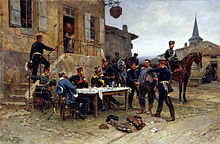
In war, espionage is considered permissible as many nations recognize the inevitability of opposing sides seeking intelligence each well-nigh the dispositions of the other. To make the mission easier and successful, combatants wear disguises to conceal their truthful identity from the enemy while penetrating enemy lines for intelligence gathering. However, if they are caught behind enemy lines in disguises, they are not entitled to prisoner-of-war condition and subject to prosecution and punishment—including execution.
The Hague Convention of 1907 addresses the condition of wartime spies, specifically within "Laws and Customs of War on Land" (Hague Iv); October 18, 1907: Chapter II Spies".[35] Article 29 states that a person is considered a spy who, acts clandestinely or on faux pretences, infiltrates enemy lines with the intention of acquiring intelligence nearly the enemy and communicate it to the argumentative during times of war. Soldiers who penetrate enemy lines in proper uniforms for the purpose of acquiring intelligence are not considered spies but are lawful combatants entitled to be treated as prisoners of war upon capture by the enemy. Article thirty states that a spy captured behind enemy lines may only be punished following a trial. Yet, Commodity 31 provides that if a spy successfully rejoined his ain military and is and so captured past the enemy equally a lawful combatant, he cannot be punished for his previous acts of espionage and must be treated as a prisoner of war. Note that this provision does not employ to citizens who committed treason against their own country or co-belligerents of that country and may be captured and prosecuted at whatever place or any time regardless whether he rejoined the military to which he belongs or not or during or later on the war.[36] [37]
The ones that are excluded from existence treated as spies while backside enemy lines are escaping prisoners of war and downed airmen every bit international law distinguishes betwixt a disguised spy and a bearded escaper.[14] It is permissible for these groups to wear enemy uniforms or civilian wearing apparel in order to facilitate their escape dorsum to friendly lines then long as they practise not assault enemy forces, collect military intelligence, or engage in similar military operations while so disguised.[38] [39] Soldiers who are wearing enemy uniforms or civilian clothes simply for the sake of warmth along with other purposes rather than engaging in espionage or similar military operations while so attired are also excluded from being treated equally unlawful combatants.[14]
Saboteurs are treated every bit spies as they also wear disguises behind enemy lines for the purpose of waging destruction on an enemy'due south vital targets in addition to intelligence gathering.[40] [41] For example, during World War II, eight German language agents entered the U.S. in June 1942 as part of Operation Pastorius, a sabotage mission against U.S. economical targets. Two weeks later, all were arrested in civilian clothes by the FBI thanks to 2 German agents betraying the mission to the U.S. Nether the Hague Convention of 1907, these Germans were classified as spies and tried by a military tribunal in Washington D.C.[42] On August iii, 1942, all eight were constitute guilty and sentenced to expiry. 5 days later, six were executed past electric chair at the Commune of Columbia jail. Two who had given testify against the others had their sentences reduced past President Franklin D. Roosevelt to prison house terms. In 1948, they were released by President Harry S. Truman and deported to the American Zone of occupied Federal republic of germany.
The U.S. codification of enemy spies is Commodity 106 of the Compatible Code of Military Justice. This provides a mandatory expiry sentence if a person captured in the act is proven to be "lurking every bit a spy or interim as a spy in or about any place, vessel, or aircraft, within the control or jurisdiction of any of the armed forces, or in or about any shipyard, any manufacturing or industrial plant, or any other place or institution engaged in work in aid of the prosecution of the war by the United states, or elsewhere".[43]
Spy fiction [edit]
Spies have long been favorite topics for novelists and filmmakers.[44] An early example of espionage literature is Kim by the English novelist Rudyard Kipling, with a description of the training of an intelligence agent in the Neat Game between the Britain and Russia in 19th century Central Asia. An even earlier work was James Fenimore Cooper's classic novel, The Spy, written in 1821, about an American spy in New York during the Revolutionary War.
During the many 20th-century spy scandals, much information became publicly known near national spy agencies and dozens of real-life hugger-mugger agents. These sensational stories piqued public interest in a profession largely off-limits to man involvement news reporting, a natural outcome of the secrecy inherent in their work. To make full in the blanks, the popular formulation of the secret agent has been formed largely past 20th and 21st-century fiction and film. Attractive and sociable real-life agents such as Valerie Plame find piddling employment in serious fiction, even so. The fictional cloak-and-dagger agent is more often a loner, sometimes amoral—an existential hero operating outside the everyday constraints of society. Loner spy personalities may have been a stereotype of convenience for authors who already knew how to write loner private investigator characters that sold well from the 1920s to the present.[45]
Johnny Fedora achieved popularity equally a fictional agent of early Cold War espionage, but James Bond is the most commercially successful of the many spy characters created past intelligence insiders during that struggle. His less fantastic rivals include Le Carré'south George Smiley, and Harry Palmer as played past Michael Caine.
Jumping on the spy bandwagon, other writers as well started writing near spy fiction featuring female spies every bit protagonists, such equally The Baroness, which has more than graphic activeness and sexual activity, equally compared to other novels featuring male protagonists.
Spy fiction has permeated the video game world likewise, in games such as Perfect Dark, GoldenEye 007, No One Lives Forever, and the Metal Gear serial.
Espionage has as well fabricated its way into comedy depictions. The 1960s TV serial Become Smart, the 1983 Finnish film Agent 000 and the Mortiferous Curves, and Johnny English film trilogy portrays an inept spy, while the 1985 flick Spies Similar U.s. depicts a pair of none-too-bright men sent to the Soviet Wedlock to investigate a missile.
The historical novel The Emperor and the Spy highlights the audacious life of U.South. Colonel Sidney Forrester Mashbir, who during the 1920s and 1930s attempted to foreclose war with Japan, and when war did erupt, he became General MacArthur's height counselor in the Pacific Theater of World War 2.[46] [47]
Black Widow is also a fictional amanuensis who was introduced equally a Russian spy, an adversary of the superhero Atomic number 26 Human. She later became an agent of the fictional spy agency Southward.H.I.East.Fifty.D. and a fellow member of the superhero team the Avengers.
See as well [edit]
- American espionage in China
- Animals used in espionage
- Chinese espionage in the Us
- Clandestine operation
- Classified data
- Dumpster diving
- Intelligence cess
- History of Soviet espionage
- Human intelligence (intelligence gathering)
- Labor spies
- List of cryptographers
- List of intelligence agencies
- List of intelligence gathering disciplines
- Armed services intelligence
- Ninja
- Operation Snowfall White
- Security clearance
- Spymaster
- Spy Museum (disambiguation)
- Jalal Haji Zawar
References [edit]
Citations [edit]
- ^ "Espionage". MI5.
- ^ Fischbacher-Smith, D., 2015. "The enemy has passed through the gate: Insider threats, the dark triad, and the challenges effectually security". Journal of Organizational Effectiveness: People and Operation, 2(2), pp. 134–156.
- ^ a b c "Espionage Facts". International Spy Museum . Retrieved 12 July 2021.
- ^ Andrew, Christopher (28 June 2018). The Surreptitious Earth: A History of Intelligence. Penguin Books Limited. ISBN9780241305225.
- ^ Danieli, Raymond Francis (April 29, 2010). "THE REVOLUTIONARY WAR SPY Equally HERO AND THE REVOLUTIONARY State of war HERO AS TRAITOR". CiteSeerXten.1.1.1012.5432.
- ^ Allen, Thomas. "Intelligence in the Civil War" (PDF). Intelligence Resource Program, Primal Intelligence Agency. Retrieved September 3, 2021.
{{cite web}}: CS1 maint: url-status (link) - ^ Arrillaga, Pauline. "China's spying seeks secret Usa info." Archived May 19, 2011, at the Wayback Machine AP, 7 May 2011.
- ^ Suvorov, Victor (1987). Inside the Aquarium. Berkley. ISBN978-0-425-09474-7.
- ^ "Inside the UAE's secret hacking squad of American mercenaries". Reuters . Retrieved 30 January 2019.
- ^ Perlroth, Nicole (6 Feb 2021). "How the United States Lost to Hackers". The New York Times. Archived from the original on 2021-12-28. Retrieved 6 Feb 2021.
- ^ Mazzetti, Mark; Goldman, Adam (fourteen September 2021). "Ex-U.S. Intelligence Officers Admit to Hacking Crimes in Piece of work for Emiratis". The New York Times. Archived from the original on 2021-12-28. Retrieved fourteen September 2021.
- ^ "Usa DISTRICT Court FOR THE DISTRICT OF COLUMBIA" (PDF). The New York Times . Retrieved xiv September 2021.
- ^ US Department of Defense force (2007-07-12). "Joint Publication 1-02 Section of Defence Dictionary of Military and Associated Terms" (PDF). Archived from the original (PDF) on 2009-eleven-08. Retrieved 2007-10-01 .
- ^ a b c Igor Primoratz (Baronial 15, 2013). New Rules for Victims of Armed Conflicts: Commentary on the Two 1977 Protocols Additional to the Geneva Conventions of 1949 (Nijhoff Classics in International Law). Martinus Nijhoff Publishers. p. 214.
- ^ a b c d "Linguistic communication of Espionage". International Spy Museum . Retrieved 12 July 2021.
- ^ "Cyber Espionage to Gainsay Terrorism" (PDF).
{{cite web}}: CS1 maint: url-status (link) - ^ "Defectors say China running 1,000 spies in Canada". CBC News. June fifteen, 2005.
- ^ "Beijing's spies price German firms billions, says espionage practiced". The Sydney Morning Herald. July 25, 2009.
- ^ Cia.gov
- ^ "Double Agent". cia.gov.
- ^ Illegal Archived January 6, 2011, at the Wayback Machine Mi5.gov. "How spies operate".
- ^ "CIA Status Improves Contractor's Case for Immunity". New America Media. Archived from the original on 2013-11-02. Retrieved 2013-08-17 .
- ^ treason Archived Dec 3, 2012, at the Wayback Machine
- ^ "espionage". Archived from the original on 3 December 2012.
- ^ spying Archived Dec 3, 2012, at the Wayback Motorcar
- ^ "Aldrich Ames Criminal Complaint". jya.com. Archived from the original on 2011-05-xiii. Retrieved 2011-03-19 .
- ^ "U.s. v. Robert Philip Hanssen: Affirmation in Support of Criminal Complaint, Arrest Warrant and Search Warrant". fas.org. Retrieved 2011-03-19 .
- ^ "Aldrich Hazen Ames Register Number: 40087-083". Bop.gov. Federal Bureau of Prisons. Archived from the original on 2012-09-19. Retrieved 2014-01-03 . (Search result)
- ^ "FBI – Aldrich Hazen Ames". FBI. Archived from the original on 2010-10-thirteen.
- ^ Gerstein, Josh (2011-03-07). "Obama's hard line on leaks". politico.com. Retrieved 2011-03-19 .
- ^ Run into the article on John Kiriakou
- ^ Your World: The Nowhere Man Archived 2019-09-fifteen at the Wayback Machine, Rupa Jha, October 21, 2012, BBC (retrieved 2012-ten-20) (Program link:The Nowhere Human)
- ^ "Archived copy". Archived from the original on 2014-09-25. Retrieved 2014-08-19 .
{{cite web}}: CS1 maint: archived copy as championship (link) - ^ "Archived re-create". Archived from the original on 2013-11-01. Retrieved 2013-08-16 .
{{cite web}}: CS1 maint: archived re-create as title (link) - ^ "Convention (Four) respecting the Laws and Customs of War on Land and its addendum: Regulations concerning the Laws and Customs of State of war on Land. The Hague, eighteen October 1907". International Committee of the Red Cantankerous.
- ^ Paul Battersby; Joseph Thousand. Siracusa; Sasho Ripiloski (2011). Law-breaking Wars: The Global Intersection of Crime, Political Violence, and International Law. Greenwood Publishing Group. p. 125.
- ^ Charlesworth, Lorie (2006). "ii SAS Regiment, War Crimes Investigations, and British Intelligence: Intelligence Officials and the Natzweiler Trial". The Periodical of Intelligence History. half dozen (2): 41. doi:10.1080/16161262.2006.10555131. S2CID 156655154.
- ^ "United States of America, Exercise Relating to Rule 62. Improper Use of Flags or Military Emblems, Insignia or Uniforms of the Adversary". International Committee of the Red Cross.
- ^ 2006 Operational Law Handbook. 2010. ISBN9781428910676.
- ^ Leslie C. Green (2000). The Contemporary Law Of Armed Disharmonize second Edition. Juris Publishing, Inc. p. 142. ISBN978-1-929446-03-ii.
- ^ George P. Fletcher (September 16, 2002). Romantics at War: Glory and Guilt in the Age of Terrorism . Princeton University Press. p. 106. ISBN9780691006512.
- ^ J. H. W. Verziji (1978). International Law in Historical Perspective: The laws of war. Part IX-A. Brill Publishers. p. 143. ISBN978-ninety-286-0148-two.
- ^ "UCMJ – Commodity 106 – Spies". About.com US Military. Archived from the original on 2013-05-15.
- ^ Brett F. Woods, Neutral Basis: A Political History of Espionage Fiction (2008) online
- ^ Miller, Toby, Spyscreen: Espionage on Picture and Goggle box from the 1930s to the 1960s (Oxford Academy Press, 2003).
- ^ Katz, Stan S. (2019). "The Emperor and the Spy". TheEmperorAndTheSpy.com. Archived from the original on 2019-09-26.
- ^ Katz, Stan Due south. (2019). The Emperor and the Spy. Horizon Productions. ISBN978-0-9903349-4-1.
Works cited [edit]
- Johnson, John (1997). The Development of British Sigint, 1653–1939. London: HMSO. OCLC 52130886.
- Winkler, Jonathan Reed (July 2009). "Information Warfare in World War I". The Journal of Military History. 73 (3): 845–867. doi:10.1353/jmh.0.0324. ISSN 1543-7795. S2CID 201749182.
Farther reading [edit]
- Aldrich, Richard J., and Christopher Andrew, eds. Cloak-and-dagger Intelligence: A Reader (2d ed. 2018); focus on the 21st century; reprints thirty essays by scholars. excerpt
- Andrew, Christopher, The Secret World: A History of Intelligence, 2018.
- Burnham, Frederick Russell, Taking Chances, 1944.
- Felix, Christopher [pseudonym for James McCarger] Intelligence Literature: Suggested Reading Listing. Us CIA. Retrieved September 2, 2012. [ dead link ] A Short Course in the Secret State of war, fourth Edition. Madison Books, November xix, 2001.
- Friedman, George. America'due south Secret State of war: Inside the Subconscious Worldwide Struggle Between the Us and Its Enemies 2005
- Gopnik, Adam, "Spy vs. Spy vs. Spy: How valuable is espionage?", The New Yorker, 2 September 2019, pp. 53–59. "In that location seems to be a paranoid paradox of espionage: the amend your intelligence, the dumber your conduct; the more you lot know, the less you lot anticipate.... Hard-won data is ignored or wildly misinterpreted.... [Information technology] happens over again and once again [that] a seeming national advance in intelligence is squandered through cross-bred confusion, political rivalry, mutual bureaucratic suspicions, intergovernmental competition, and fear of the press (as well every bit leaks to the printing), all seasoned with dashes of sexual jealousy and adulterous intrigue." (p. 54.)
- Jeffreys-Jones, Rhodri. In Spies, We Trust: The Story of Western Intelligence (2013), covers U.Due south. and United kingdom
- Jenkins, Peter. Surveillance Tradecraft: The Professional's Guide to Surveillance Grooming ISBN 978-0-9535378-2-2
- Kahn, David, The Codebreakers: The Comprehensive History of Surreptitious Communication from Aboriginal Times to the Cyberspace, 1996 revised edition. First published 1967.
- Keegan, John, Intelligence in War: Knowledge of the Enemy from Napoleon to Al-Qaeda, 2003.
- Knightley, Phillip, The Second Oldest Profession: Spies and Spying in the Twentieth Century, Norton, 1986.
- Lerner, Brenda Wilmoth & K. Lee Lerner, eds. Terrorism: essential main sources Thomas Gale 2006 ISBN 978-1-4144-0621-3
- Lerner, K. Lee and Brenda Wilmoth Lerner, eds. Encyclopedia of Espionage, Intelligence and Security (2003), worldwide recent coverage 1100 pages.
- May, Ernest R. (ed.). Knowing I's Enemies: Intelligence Cess Before the Two World Wars (1984).
- O'Toole, George. Honorable Treachery: A History of U.S. Intelligence, Espionage, Covert Activeness from the American Revolution to the CIA 1991
- Murray, Williamson, and Allan Reed Millett, eds. Calculations: net assessment and the coming of World War Ii (1992).
- Owen, David. Hidden Secrets: A Complete History of Espionage and the Technology Used to Support Information technology
- Richelson, Jeffery T. A Century of Spies: Intelligence in the Twentieth Century (1977)
- Richelson, Jeffery T. The U.Due south. Intelligence Customs (1999, quaternary edition)
- Smith, W. Thomas Jr. Encyclopedia of the Key Intelligence Agency (2003)
- Tuchman, Barbara W., The Zimmermann Telegram, New York, Macmillan, 1962.
- Warner, Michael. The Rise and Fall of Intelligence: An International Security History (2014)
External links [edit]
 | Wikimedia Commons has media related to Espionage. |
 | Wikiquote has quotations related to: Espionage |
 | Await up espionage in Wiktionary, the free dictionary. |
- History of an espionage in Russia
gregoirehostall40.blogspot.com
Source: https://en.wikipedia.org/wiki/Espionage
0 Response to "What Do You Know About Secret Agents"
Post a Comment